Bowing Foundation Wall Repair in Grand Rapids, MI
Carbon fiber straps and wall anchors stop lateral movement and stabilize bowing basement walls. Free inspections — call (616) 213-1708.
What Causes Bowing Foundation Walls
Bowing basement walls are caused by lateral pressure from saturated soil pushing inward against the foundation. Clay soil — the dominant soil type throughout West Michigan — absorbs water and expands significantly, then contracts as it dries. This cyclical swelling and shrinking applies intense pressure to the wall face year after year. The wall bows inward at its midpoint, typically accompanied by horizontal cracking at mortar joints in block foundations or horizontal cracking in poured concrete walls near the center of the span. Once inward movement begins, it does not self-correct. Each Grand Rapids winter, as soils freeze and expand, the pressure increases and the wall moves further in. Acting early — while movement is less than 2 inches — is the difference between a carbon fiber solution and an anchor system or full wall replacement.
Get a Free Estimate →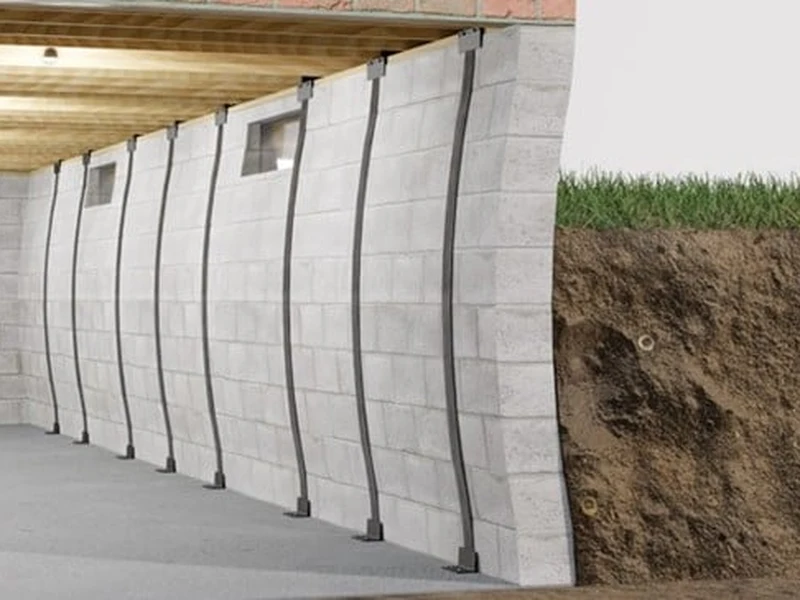
Repair Options by Severity
The right repair is determined by how much the wall has already moved inward. Less than 2 inches of bowing: carbon fiber straps are the preferred solution. High-tensile-strength carbon fiber panels are bonded directly to the wall surface with structural epoxy, secured to the floor and floor joist above, and prevent any further inward movement. No excavation, no heavy equipment — most jobs are done in a day. Cost range: $1,500–$3,500 for a typical wall. 2–4 inches of bowing: wall anchors are required. A steel plate is attached to the interior wall, a connecting rod extends through the soil, and a second anchor plate is buried in stable soil well beyond the active pressure zone. The system is tightened each year to gradually pull the wall back toward plumb. Cost range: $3,000–$6,000. Over 4 inches or rapidly accelerating movement: full structural assessment is required immediately — some walls in this condition require replacement.
Get a Free Estimate →Why Prompt Action Matters
A bowing wall that is monitored but not repaired will continue to move — the soil pressure does not stop. Grand Rapids freeze-thaw cycles add measurable inward pressure every winter, and a wall at 1 inch of bowing today is commonly at 2.5–3 inches within 3–5 years of inaction. That progression moves the repair from a carbon fiber solution at around $2,000 to a wall anchor system at $5,000 or more. Walls that are allowed to reach 4+ inches of bowing, or that develop accelerating movement, may require full excavation and wall replacement — a project that runs $15,000–$40,000 and involves significant disruption to landscaping, driveways, and utilities. Choosing carbon fiber at $2,000 today versus wall replacement at $30,000 later is not a close financial decision. If you can see your basement wall is not plumb, call us now.
Get a Free Estimate →Bowing wall getting worse every winter? Free inspection — carbon fiber stops it today.
(616) 213-1708Bowing Wall Repair — Frequently Asked Questions
How much does bowing wall repair cost in Grand Rapids?
Carbon fiber strap systems for walls with less than 2 inches of bowing typically run $1,500–$3,500. Wall anchor systems for walls bowed 2–4 inches range from $3,000–$6,000. Severe cases requiring structural assessment, pier reinforcement, or wall replacement are higher and will be quoted after inspection.
Can a bowing foundation wall be straightened?
Yes, with a wall anchor system. Anchors allow gradual straightening — typically about 1/8 inch per tightening cycle performed annually — as soil pressure relaxes over time. Carbon fiber straps lock the wall in place and prevent further movement but do not reverse existing deflection.
Does bowing wall repair require excavation?
No — both carbon fiber strap systems and wall anchor installations are performed entirely from the interior. No excavation is needed, so your landscaping, driveway, and exterior are not disturbed.
How do I know if my bowing wall is getting worse?
Hold a long straight edge or level against the center of the wall and measure the gap. Mark the wall with tape, date it, and re-measure monthly. Any new inward movement exceeding 1/4 inch warrants an immediate call — don't wait for a seasonal inspection if movement is accelerating.
Get a Free Bowing Wall Inspection in Grand Rapids
We inspect bowing and cracked foundation walls throughout Grand Rapids, Kentwood, Wyoming, Walker, Grandville, Caledonia, Ada, and East Grand Rapids. We measure the deflection, assess the rate of movement, and give you a clear, honest recommendation.